Informative
•
12 min read
Best Usage-Based Billing Software for SaaS Companies in 2026
Published on

AI summary
Traditional billing tools weren't built for how modern SaaS companies actually price their products. If your costs vary by token, API call, GPU hour, or any usage metric, flat-rate or per-seat billing creates a structural profitability problem you end up subsidizing your heaviest users. This guide compares five usage-based billing platforms with pricing verified directly from each product's website in March 2026. Fluxrate is the strongest choice for AI companies and infrastructure platforms that need real-time metering, no-code pricing configuration, and enterprise contract support out of the box. Stripe Billing works for teams already on Stripe with simple usage needs, but its batch metering and lack of pricing flexibility become constraints as complexity grows. Lago is the only serious open-source option self-hosting is available on the Enterprise tier, and its customer roster (Mistral AI, Groq, CoreWeave) validates it at scale, but it requires DevOps capacity to run. Metronome offers a free Starter tier with real-time event ingestion and strong enterprise contract support worth evaluating early, though its January 2026 acquisition by Stripe introduces long-term roadmap uncertainty. Chargebee has the most generous entry point (free until $250K cumulative billing) and the deepest subscription operations tooling, but usage-based billing is architecturally secondary to its subscription core. The decision comes down to your pricing model today and how fast it will evolve. If you're building AI or infrastructure, choose Fluxrate. If you're subscription-first adding usage components, Chargebee. If you need to own your stack, Lago. If you want to start free and scale into sophistication, Metronome.
The Billing Stack Is Broken for Modern SaaS
If you're building a SaaS product in 2026 especially in AI, infrastructure, or developer tools the way you bill your customers is no longer an afterthought. It's infrastructure.
The old model was simple: pick a plan, pay per seat, invoice monthly. But that model assumes your product is a spreadsheet a fixed thing people access at a fixed rate.
Modern software isn't like that. AI products charge per token. Infrastructure tools charge per GB, per API call, per model invocation. Developer platforms charge across multiple dimensions simultaneously. The pricing surface is complex, it changes frequently, and one-size billing tools weren't built to handle it.
The result? Engineering teams waste months building billing logic that shouldn't exist. Finance teams fight spreadsheets trying to reconcile usage. Customers get surprised by invoices they can't understand. And product teams can't ship pricing experiments without touching code.
The Real Question: It's not 'do I need a billing platform?' It's 'which one won't slow me down?' This guide gives you a verified, side-by-side answer. |
|---|
In this guide, we compared the five most relevant usage-based billing platforms for SaaS companies in 2026. Every pricing claim is sourced directly from each product's official pricing page no estimates, no outdated screenshots.
Who this is for: Series A–B SaaS and AI companies choosing a billing platform, teams migrating off manual billing or Stripe-only setups, and founders who need to ship flexible pricing without a 6-month engineering project.
What Actually Matters in a Billing Platform
Before we get into the tools, here's the framework we used to evaluate each platform. These are the criteria that matter in practice, not on a features checklist.
1. Metering Architecture
Real-time metering vs. batch metering is the single biggest differentiator between billing platforms. Batch metering where usage is aggregated on a delay means your customers are billing against stale data. Real-time metering means every event is priced immediately. For AI companies, the difference between these two is the difference between confident scaling and constant firefighting.
2. Pricing Flexibility Without Engineering
How long does it take to ship a pricing change? If the answer involves a pull request, a staging environment, and a two-week review cycle, that's a product velocity problem. The best platforms let you configure and iterate on pricing logic without code deployments.
3. Enterprise-Readiness from Day One
Enterprise deals require committed spend, volume discounts, prepaid credits, ramp schedules, and custom contract terms. If your billing platform doesn't support this natively, you'll end up managing enterprise contracts in spreadsheets which breaks at the first renewal conversation.
4. Developer Experience
How good is the API? Is the documentation accurate and complete? How long does integration actually take not the marketing claim, but realistic engineering hours? A billing platform your team hates using will always be a source of technical debt.
5. Customer Visibility
Your customers need to see their usage in real time. Not in an email digest. Not on a monthly invoice. Today. An embedded customer portal that shows live spend prevents bill shock, reduces support tickets, and builds trust especially when customers are on variable pricing.
6. Pricing Transparency
This matters more than it sounds. Platforms that hide their pricing behind 'contact sales' aren't just inconvenient they make it impossible to budget, compare, or make a fast decision. Where we were able to verify specific pricing, we have. Where platforms require a sales call, we've said so.
Fluxrate - Built for AI SaaS Companies
Editor's Choice: Best for AI companies, infrastructure platforms, and Series A–B SaaS building usage-based pricing from day one. |
|---|
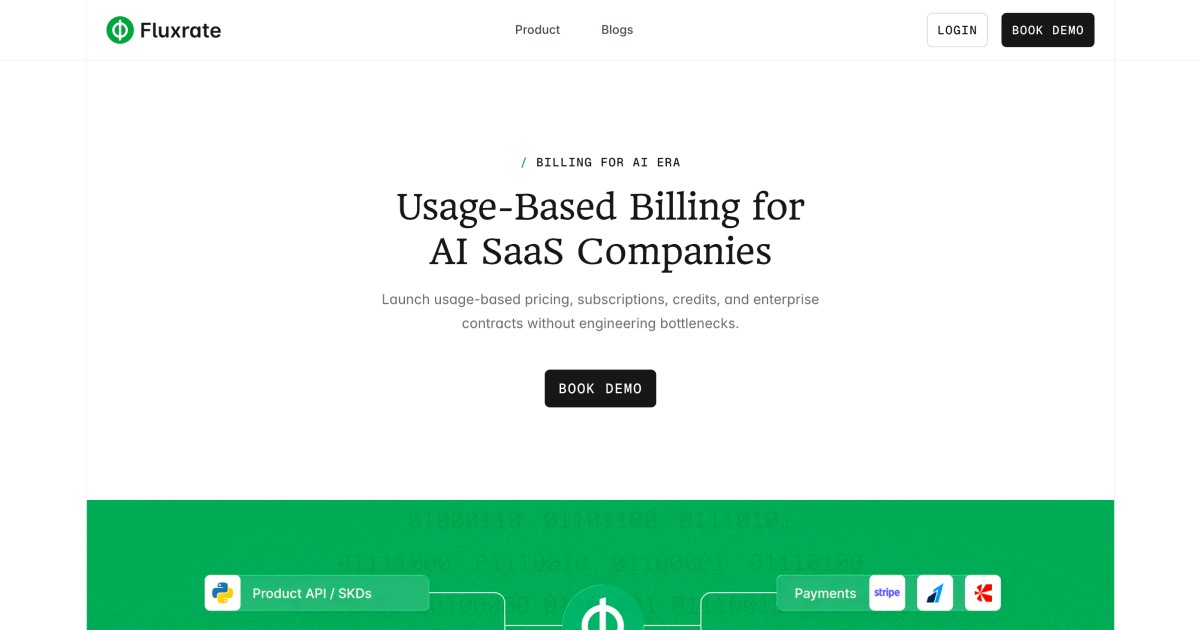
Fluxrate is billing infrastructure designed specifically for the pricing models that modern software companies actually use token-based, credit-based, compute-hour, hybrid, and everything in between. Unlike platforms that added 'usage-based' capabilities on top of a subscription core, Fluxrate was architected from scratch for event-driven, real-time billing.
The core promise: integrate in hours, not weeks, and ship pricing changes through configuration rather than code. That's not marketing language it reflects a genuine architectural choice to expose pricing logic as a first-class API resource rather than hardcoded billing schedules.
What Makes Fluxrate Different
Real-time event metering every usage event is processed and priced immediately, not batched
No-code pricing configuration update pricing models, thresholds, and tiers without engineering involvement
AI-native feature set native support for token billing, GPU hours, credit wallets, and multi-dimensional pricing
Enterprise contract support out of the box committed spend, prepaid credits, ramp deals, and volume discounts
Embedded customer portal customers see their live usage, projected costs, and historical data inside your product
Who It's Built For
Fluxrate's design center is AI companies (LLM API providers, AI SaaS products, model infrastructure) and developer-facing platforms where pricing is complex, changes frequently, and the customer base demands transparency. It's also well-suited for any Series A–B SaaS company that doesn't want to spend an engineering quarter on billing infrastructure before they've proven their pricing model.
Pricing
Fluxrate uses transparent usage-based pricing with no setup fees. Contact Fluxrate directly for current tier details at fluxrate.co.
When to Choose Fluxrate
You're an AI company billing on tokens, GPU hours, or credits
You need to ship pricing experiments weekly, not quarterly
Your pricing doesn't fit standard SaaS plan templates
Developer experience and integration speed are non-negotiable
You want enterprise contract support without enterprise implementation timelines
When It's Not the Right Fit
You run a pure subscription business with no usage component
You need the brand recognition of a legacy platform for procurement reasons
Stripe Billing - Best for Simple Usage on an Existing Stripe Stack
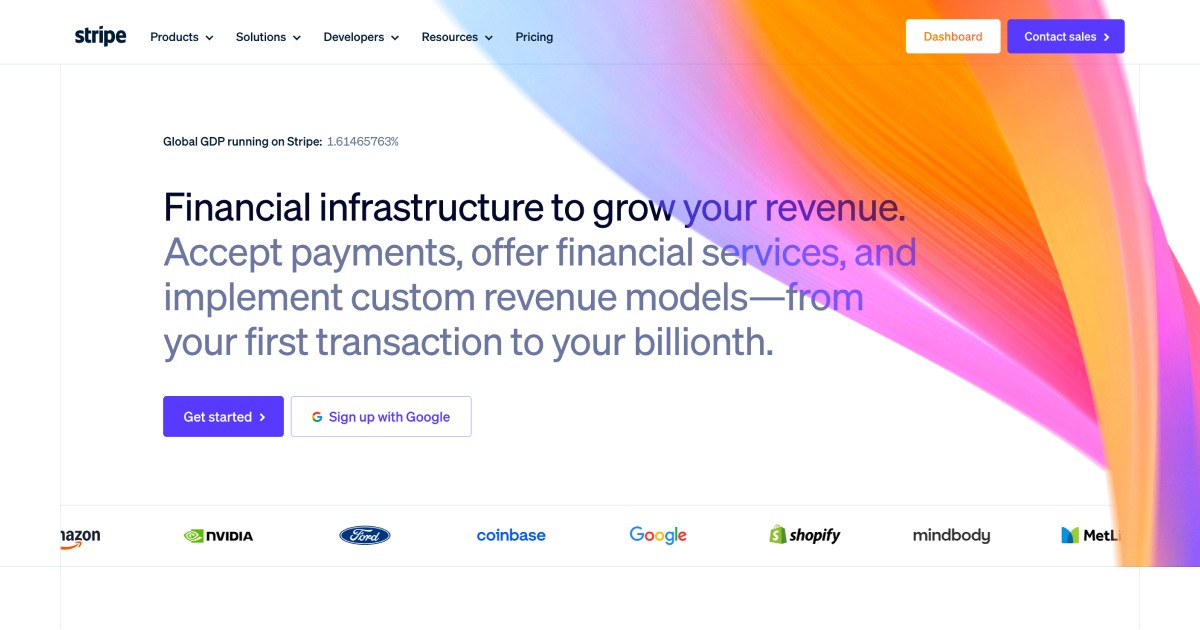
Stripe Billing is the default billing layer for millions of companies that are already on Stripe Payments. If you're collecting payments through Stripe today and have relatively simple usage-based needs think tiered pricing or basic metered overages Stripe Billing is the path of least resistance.
It's worth being precise about what Stripe Billing is and isn't. Stripe is primarily a payment processor. Stripe Billing is the subscription and invoicing layer on top of that. It has added metered billing capabilities, but metering is not its core architecture.
Pricing
Product / Feature | Verified Pricing |
|---|---|
Payments (standard) | 2.9% + 30¢ per successful domestic card transaction |
Billing (pay as you go) | 0.7% of billing volume (no monthly fee) |
Billing (monthly plan) | Starting at $620/month (1-year contract) |
Invoicing (starter) | 0.4% per paid invoice |
Tax (basic, API) | $0.50 per transaction (where registered) |
International cards | +1.5% on top of standard rate |
Source: stripe.com/pricing (verified March 2026)
Where Stripe Billing Works
You already use Stripe Payments and want one vendor
Your usage model is simple tiered plans with light overages
You need reliable payment processing with global reach (195 countries, 100+ payment methods)
Fraud protection (Radar) and payment optimization are priorities
G2 Rating (2026) Stripe Billing: 4.4/5 from 137 verified reviews on G2. Top praise: ease of use, ecosystem integration, and reliable dunning. Top complaint: fees become expensive at scale; limited configurability for complex usage models. Source: g2.com/products/stripe-billing/reviews |
Where Stripe Billing Struggles
Metering is batch-based, not real-time not suitable for live usage dashboards
Pricing changes require code deployments no no-code configuration layer
Complex usage models (multi-dimensional, AI token billing) require custom engineering
No native enterprise contract managemen committed spend, credits, and ramp deals need custom builds
Customer usage portal is limited
Bottom Line: Stripe Billing is the right answer when billing is not a competitive differentiator for your business and you're already in the Stripe ecosystem. If your pricing model is going to evolve, Stripe will become a constraint. |
|---|
Lago - Best Open-Source Option for Self-Hosted Billing
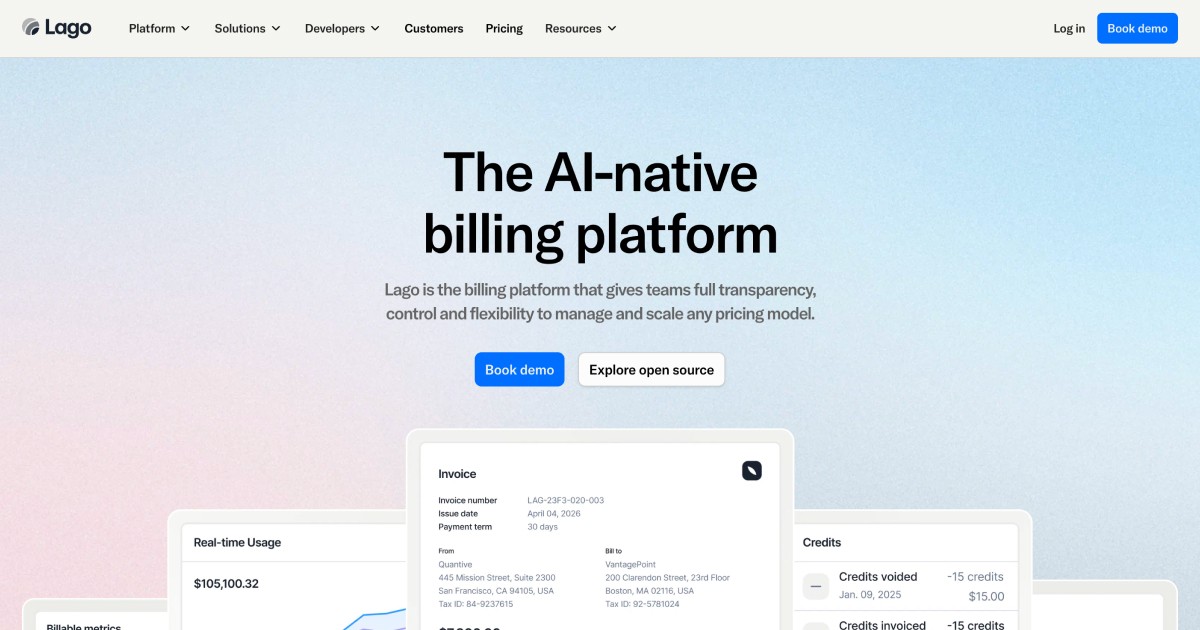
Lago is the only major open-source billing platform in this comparison. YC-backed and actively developed, it's designed for teams that need full control over their billing infrastructure either for compliance reasons, data sovereignty, or an open-source philosophy.
Lago's customer base includes notable names: Mistral AI, Groq, Synthesia, CoreWeave, and PayPal are listed on their site. That's meaningful signal — these are serious engineering organizations that evaluated alternatives and chose Lago.
Pricing
Tier | Business | Enterprise |
|---|---|---|
Pricing | Contact sales | Contact sales |
Self-hosted | Lago Cloud only | Available |
Support | Business hours + Slack | 24/7 premium + solutions engineer |
Open Source | Available on GitHub | Available on GitHub |
Progressive billing | Add-on | Add-on |
Security | SOC 2 Type II, RBAC | SOC 2 Type II, RBAC |
Source: getlago.com/pricing (verified March 2026). Note: No public per-seat or percentage pricing is listed all tiers are contact-sales only.
Community Signal (2026) Lago has no standalone G2 billing profile with sufficient reviews to cite a rating. Social proof comes from their customer roster: Mistral AI, Groq, CoreWeave, Synthesia, and PayPal — all serious engineering organizations. Source: getlago.com/customers |
What Lago Does Well
Full open-source codebase you can audit, fork, and extend it
Self-hosted deployment available on Enterprise tier (VPC, on-prem)
Real-time metering with flexible billable metrics
Lago AI-powered billing intelligence as an add-on
Multi-entity billing support across both tiers
Proven at scale customers include Mistral AI, Groq, CoreWeave
Limitations to Understand
All paid pricing is contact-sales no transparent starting price
Self-hosting requires DevOps capacity and ongoing maintenance
Some key features (progressive billing, tax integrations, CRM connectors) are paid add-ons even on Business tier
Smaller ecosystem and community than Stripe
Bottom Line: Lago is the right choice when you need to own your billing infrastructure — whether for compliance, data residency, or open-source principles. It's not the fastest path to market, but it's the most controllable. |
|---|
Metronome - Now Part of Stripe, Built for Scale-Ups
In late 2024, Metronome was acquired by Stripe. Their current pricing page is explicit about this: 'Metronome is now part of Stripe. Together, we're building the future of monetization infrastructure.'
This acquisition has significant implications. On one hand, Metronome now benefits from Stripe's infrastructure and distribution. On the other, its longer-term product roadmap will be shaped by Stripe's priorities which is relevant context for any company evaluating a multi-year billing infrastructure commitment.
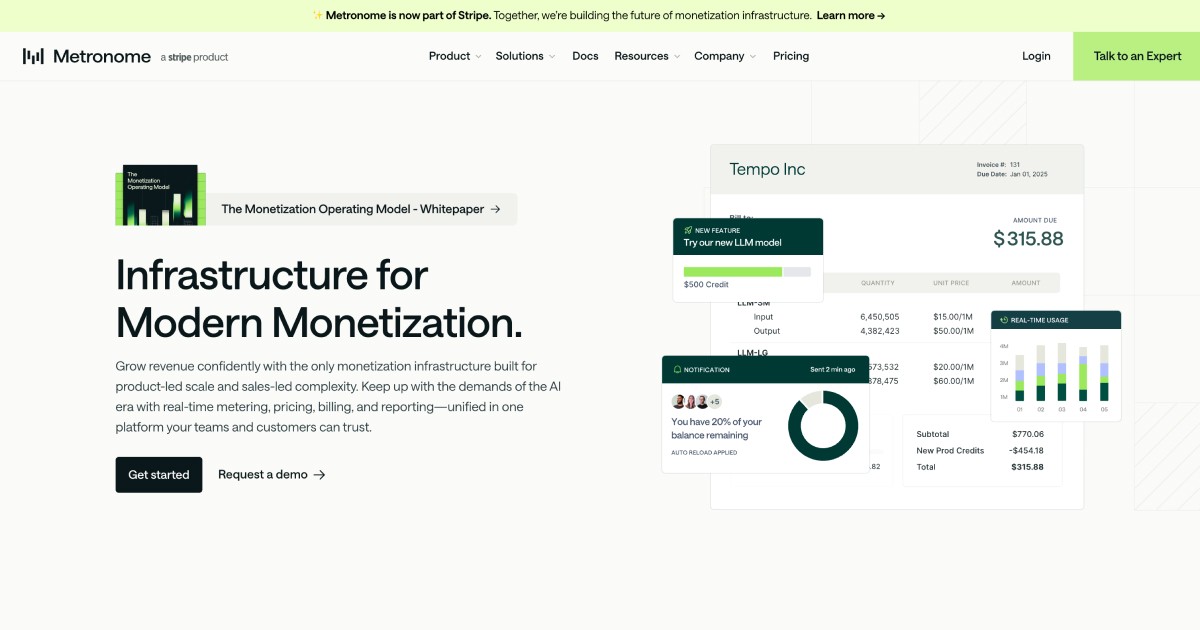
Metronome's architecture centers on SQL-based billable metrics, centralized rate cards, and a modular approach to pricing building blocks. It was built for companies where pricing complexity is genuinely high and the engineering team is capable of sophisticated implementation.
In January 2026, Stripe acquired Metronome. According to reporting at the time, the deal was valued at roughly $1 billion a signal of how seriously Stripe views usage-based billing infrastructure as a strategic gap in their product stack. Metronome's own blog confirmed the deal, framing it as an opportunity to build even better products within Stripe's platform.
Pricing
Feature | Starter (Free) | Custom |
|---|---|---|
Pricing | Free Sandbox Access (for production contact sales) | Contact sales (tailored pricing) |
Real-time event ingestion | Included | Included |
Pricing types | Usage, seat, subscription, hybrid | Same + tailored |
Enterprise contracts | Included | Included |
Salesforce / NetSuite / Cloud Marketplace integrations | Not included | Included |
Dedicated account manager | Not included | Included |
Data warehouse exports | Not included | Included |
Native Stripe integration | Included | Included |
Source: metronome.com/pricing (verified March 2026).
What Metronome Does Well
Free Starter tier genuinely useful for teams launching usage-based products
Real-time event ingestion from day one
SQL-based billable metrics give technically sophisticated teams maximum flexibility
Strong enterprise contract support including Cloud Marketplace billing (AWS, Azure, GCP)
Native Stripe integration (particularly relevant post-acquisition)
Limitations to Understand
Acquisition by Stripe creates roadmap uncertainty for teams evaluating long-term vendor independence
Custom tier pricing is opaque requires a sales conversation
Most enterprise integrations (Salesforce, NetSuite, data warehouse) are Custom tier only
The Starter tier is capable but limited for teams that need CRM/ERP workflow integration
Bottom Line: Metronome is strong for scale-up companies that need sophisticated billing infrastructure and are comfortable with Stripe's broader ecosystem. The free Starter tier makes it worth evaluating early, even if you expect to upgrade later. |
|---|
Chargebee - Best for Subscription-First SaaS Adding Usage
Chargebee is one of the most established billing platforms in the market, with a long track record across B2B SaaS, media, e-commerce, and education. Its core strength is subscription billing: complex subscription lifecycles, dunning management, revenue recognition, and an extensive integration catalog.
Usage-based billing is a genuine capability in Chargebee it supports custom usage metering and aggregation but it's architecturally secondary to subscriptions. If you're a subscription-heavy business that needs to add usage-based components, that's the right trade-off. If usage is your primary billing model, the architecture will show its edges.
G2 Rating (2026) Chargebee: 4.4/5 from 949 verified reviews G2 Leader in Subscription Management for 27 consecutive quarters as of Winter 2026. Top praise: intuitive UI, automation, and broad integrations. Top complaint: pricing jumps steeply between tiers; usage billing feels less native than subscription features. Source: g2.com/products/chargebee/reviews |
|---|
Pricing
Tier | Starter | Performance |
|---|---|---|
Pricing | Free up to $250K cumulative billing, then 0.75%/month | $7,188/yr (up to $100K billing/month) |
Enterprise | Not available | Contact sales (multi-entity, contracts, etc.) |
Usage-based pricing | ✅ Custom metering included | ✅ Custom metering included |
Payment gateways | 35+ | 35+ |
Dunning (Smart) | ❌ Performance tier+ | ✅ Included |
RevRec (Revenue Recognition) | Separate product | Separate product |
Source: chargebee.com/pricing (verified March 2026). Enterprise tier pricing is contact-sales only.
What Chargebee Does Well
Generous Starter tier free until $250K cumulative billing, then 0.75% lowest barrier to entry of any paid platform in this list
Most extensive integration catalog 35+ payment gateways, deep CRM and accounting connections
Revenue recognition as a standalone product (ASC 606 / IFRS 15 compliant)
CPQ capability configure, price, quote for sales-assisted deals
Customer retention tooling built-in
Limitations to Understand
Usage-based metering is an add-on to a subscription core, not native real-time infrastructure
Smart Dunning requires Performance tier not available on Starter
Revenue Recognition, CPQ, and Retention are separate products with separate pricing
Performance tier ($7,188/yr) caps at $100K billing/month moderate scale
Enterprise tier pricing is opaque (contact sales)
Not designed for AI/infrastructure billing patterns
Bottom Line: Chargebee makes the most sense for subscription-heavy SaaS businesses that need mature revenue operations tooling dunning, RevRec, CPQ and want to add usage-based billing incrementally. The Starter tier's generosity makes it easy to start without commitment. |
|---|
Side-by-Side Comparison
Feature | Fluxrate | Stripe Billing | Lago | Metronome | Chargebee |
|---|---|---|---|---|---|
Metering | Real-time | Batch | Real-time | Real-time | Batch |
Pricing Flexibility | ⭐⭐⭐⭐⭐ | ⭐⭐ | ⭐⭐⭐⭐ | ⭐⭐⭐⭐⭐ | ⭐⭐⭐ |
Dev Experience | ⭐⭐⭐⭐⭐ | ⭐⭐⭐⭐ | ⭐⭐⭐ | ⭐⭐⭐⭐ | ⭐⭐ |
Transparent Pricing | ✅ Yes | ✅ Yes | Contact Sales | Contact Sales | Contact Sales |
Open Source | ❌ | ❌ | ✅ Yes | ❌ | ❌ |
Free Tier / Trial | Free | PAYG | Contact sales | Free Starter | Free to $250K |
Best For | AI/Modern SaaS | Simple usage | Self-hosted | Scale-ups | Sub-heavy SaaS |
Note: Pricing data verified from official product websites, March 2026. 'Contact sales' indicates no publicly listed pricing.
Which Platform Is Right for You?
Here's the decision framework we'd actually use with a founding team:
You're an AI or infrastructure company (Series A–B)
Fluxrate. Your pricing model is complex, it will change, and you need real-time metering from day one. Don't spend engineering cycles on billing infrastructure when your team should be shipping product.
You're already on Stripe and your pricing is simple
Stripe Billing. If your usage model is light tiered plans with basic overages the path of least resistance is staying in the Stripe ecosystem. Just understand its ceiling.
You need to own your billing infrastructure (compliance, data sovereignty)
Lago. The only serious open-source option. Budget for DevOps capacity if you're self-hosting. The open-source repo is available on GitHub evaluate it before you commit.
You're scaling revenue and need sophisticated billing without vendor lock-in concerns
Metronome. Start on the free tier and evaluate Custom pricing as you scale. Be aware of the Stripe acquisition context if long-term vendor independence matters to you.
You're a subscription-first SaaS adding usage-based components
Chargebee. Mature subscription infrastructure, the most generous free tier in this comparison, and strong revenue operations tooling. Usage-based is supported, but subscription is the core.
Frequently Asked Questions
Q1. What's the difference between a billing platform and a payment processor? A payment processor (like Stripe Payments, PayPal) handles the movement of money — the actual transaction between customer and business. A billing platform (like Fluxrate, Metronome, Lago) handles everything upstream of that: metering usage, calculating what a customer owes, managing pricing logic, generating invoices, and presenting usage data to customers. Most billing platforms integrate with a payment processor rather than replacing it.
Q2. Do I need a billing platform if I'm already on Stripe? It depends on your pricing complexity. Stripe Billing handles simple subscription and metered use cases well. If you need real-time usage metering, no-code pricing experimentation, enterprise contract management, or a live usage portal for customers — Stripe Billing will show its limitations. That's when a dedicated billing platform becomes necessary.
Q3. How long does implementation actually take? This varies significantly by platform and use case. For a simple integration on a modern platform like Fluxrate or Metronome, engineering teams typically complete the initial integration within days. Complex enterprise integrations with Salesforce, NetSuite, and custom contract workflows take longer weeks to months depending on your existing stack. The difference between 'hours to first event' and 'weeks to full production' matters clarify this expectation with any vendor before signing.
Q4. What happens as my pricing model evolves? This is one of the most important questions to ask during evaluation. Some platforms require code deployments to change pricing logic; others expose pricing configuration through APIs or a dashboard without engineering involvement. If you expect to experiment with pricing and you should the cost of shipping pricing changes should be a primary evaluation criterion, not a footnote.
Q5. Should I build my own billing system? In most cases, no. Building production-ready billing infrastructure metering, pricing engine, invoicing, payment collection, tax compliance, customer portal — is a 6–18 month engineering project that easily exceeds $150K-$500K in engineering time. The edge case where it makes sense: billing logic is core to your competitive IP (you're selling billing as a feature), and you have dedicated engineering capacity to maintain it indefinitely. For everyone else, buy.
The Bottom Line
Usage-based billing isn't optional anymore. If your product has variable costs tokens, API calls, compute, storage, anything that varies by customer flat pricing is a path to subsidizing your worst accounts at the expense of your best ones.
The good news is that the infrastructure to do this correctly is better than it's ever been. The platforms in this guide have collectively made it possible to launch sophisticated usage-based pricing in days rather than quarters.
The decision comes down to where you are and where you're going:
Building an AI company or infrastructure product? → Fluxrate
Already on Stripe with simple needs? → Stripe Billing
Need to own your stack? → Lago
Scaling fast and need sophisticated billing? → Metronome
Subscription-first adding usage? → Chargebee
Pick the tool that matches your current complexity and has enough room to grow with your pricing model. The worst outcome isn't picking the wrong platform — it's delaying the decision and ending up with six months of custom billing code that still doesn't work.
Read our AI billing guide: fluxrate.co/blog/usage-based-billing-for-ai-companie
Ready to see Fluxrate in action?
Fluxrate is the billing operating system built for next-generation software companies. Integrate in hours. Ship pricing changes without code. Built natively for AI, infrastructure, and developer tools.
Share on